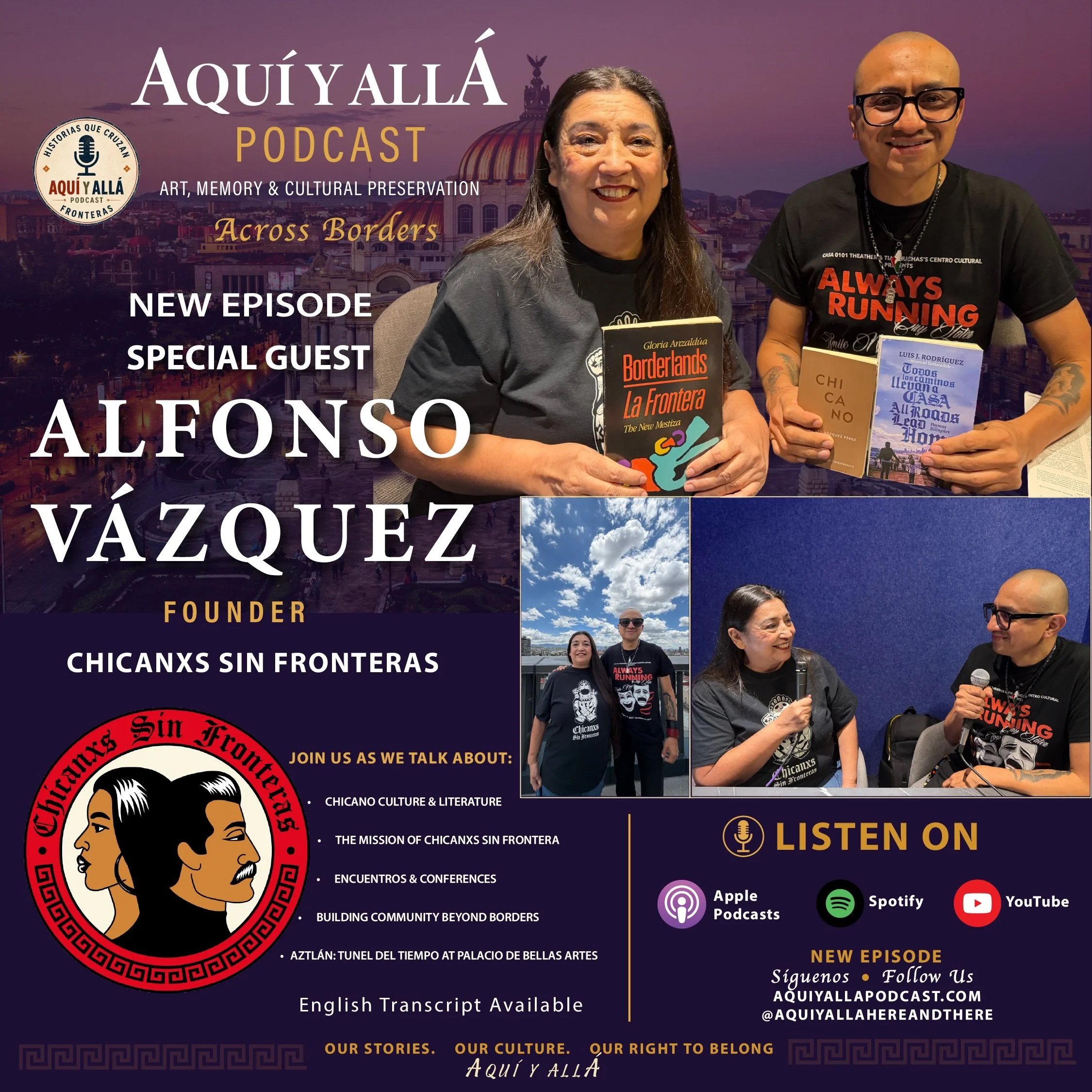
Promotional poster for the 'Aquí y Allá' podcast featuring two smiling people dressed in cultural attire, with text announcing podcast launch on May 11, 2026, available on various platforms.

Aquí y Allá / Here and There is a binational cultural platform rooted in México and the United States, documenting and amplifying the lived experiences of artists, migrants, and cultural bearers whose identities, histories, and creative practices move across borders.

From Mexico City to communities across the United States, the podcast centers Mexicans, Chicanos, Latin Americans, and Caribbean voices, while also engaging Indigenous and diasporic communities—including those preserving culture across generations and geographies.

Through storytelling, oral history, and artistic dialogue, Aquí y Allá explores migration, return, belonging, language, memory, and the ongoing work of cultural preservation in a time of global displacement and transformation.

New Podcast Episodes


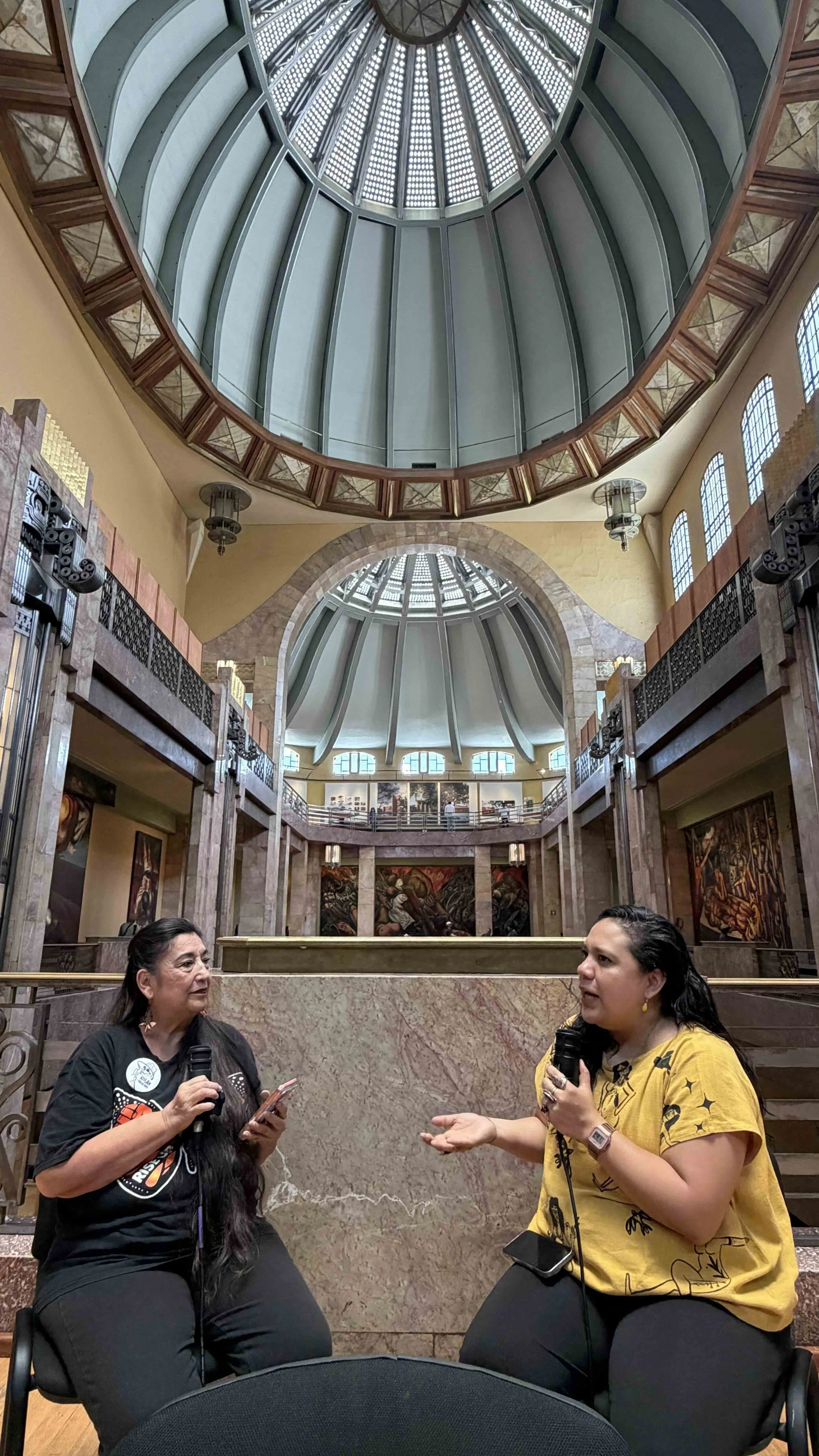
Our first featured guest is renowned artist, educator, and cultural leader Eugene Rodriguez, whose reflections on art, community, migration, memory, and cultural preservation help frame the vision and purpose of this new platform.

Upcoming Art Exhibitions and Events


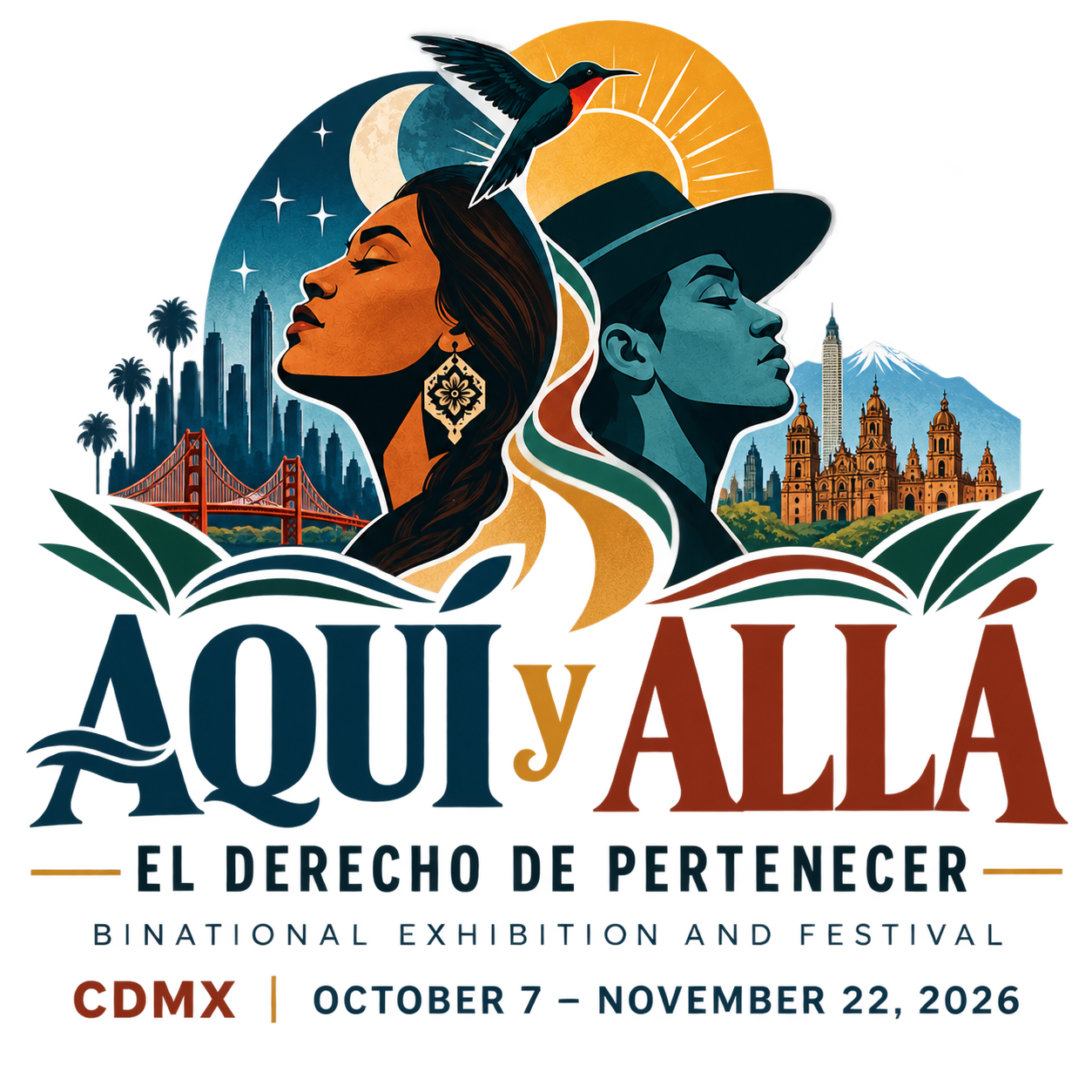
Aquí y Allá: El Derecho de Pertenecer

Ni de Aquí, Ni de Allá—¿Y Ahora Qué?

(Here and There: The Right to Belong / Neither Here Nor There—Now What?)

In this historical moment—marked by political extremism, mass displacement, and the slow violence of cultural erasure—migration can no longer be understood as a single act of crossing. It is not a beginning or an end. It is a condition. It is a continuum. It is a life lived across borders, languages, and systems of power.

Aquí y Allá: El Derecho de Pertenecer is a binational exhibition that brings together Latin American and Chicano artists living in the United States alongside Mexican and Latin American artists working within Mexico and across the region. Presented in Mexico City, the exhibition positions the city not merely as a host, but as a critical site of encounter—where histories converge, identities are renegotiated, and the meaning of belonging is actively contested.

This exhibition begins with a shift in perspective.

For decades, dominant narratives of migration have focused on departure—on the act of leaving, of crossing into the United States, of arrival into the “other side.” But today, another reality demands attention: return.

Return through deportation.
Return through self-deportation.
Return through necessity, survival, or choice.

And in that return, something fundamental is revealed:

Migration does not end at the border. It begins again.

Mexico stands at the center of this unfolding reality. It is a pass-through for Latin Americans navigating perilous migration routes. It is a site of return for those expelled from the United States. And it remains the motherland for Chicanos—whose identities have been shaped in the tension between inheritance and displacement, memory and reinvention.

Yet return is not a simple homecoming.

Those who come back often arrive as strangers in familiar lands—carrying hybrid identities, altered cultural references, and languages shaped by absence and adaptation. English may dominate. Spanish may fracture. Spanglish emerges not as deficiency, but as evidence of survival. Accent becomes a marker. Identity becomes a negotiation.

They are seen—and misseen.

They are recognized—and rejected.

They are told, implicitly and explicitly, that they are no longer fully from here, nor entirely from there.

Ni de aquí, ni de allá.

This exhibition inhabits that in-between space—not as a deficit, but as a powerful site of cultural production, resistance, and transformation.

Artists based in the United States expose the mechanisms of power that shape migrant life: detention, surveillance, racialization, and the criminalization of movement. Their work reveals how policy enters the body—how it fragments families, alters futures, and attempts to erase cultural presence.

Artists based in Mexico and across Latin America respond from another vantage point: they witness the arrival of returnees, the emergence of new identities, and the tensions that arise when national belonging is disrupted. Their work interrogates how societies receive their own—how authenticity is policed, how difference is marked, and how solidarity is built or withheld.

Together, these perspectives form a binational dialogue—a conversation across borders that is as much about perception as it is about lived experience.

At stake are urgent questions:

  • Who has the right to belong?

  • What defines cultural authenticity—and who gets to decide?

  • How do language, memory, and tradition survive displacement?

  • What responsibilities do nations hold toward those who leave—and those who return?

In this context, cultural erasure is not metaphorical. It is enacted through policy, through rhetoric, through the systematic dismantling of identity, history, and community. It is a form of violence that operates slowly, persistently—reshaping how people see themselves and how they are seen by others.

And yet, against this, artists insist.

They create.
They document.
They remember.
They transform.

They refuse disappearance.

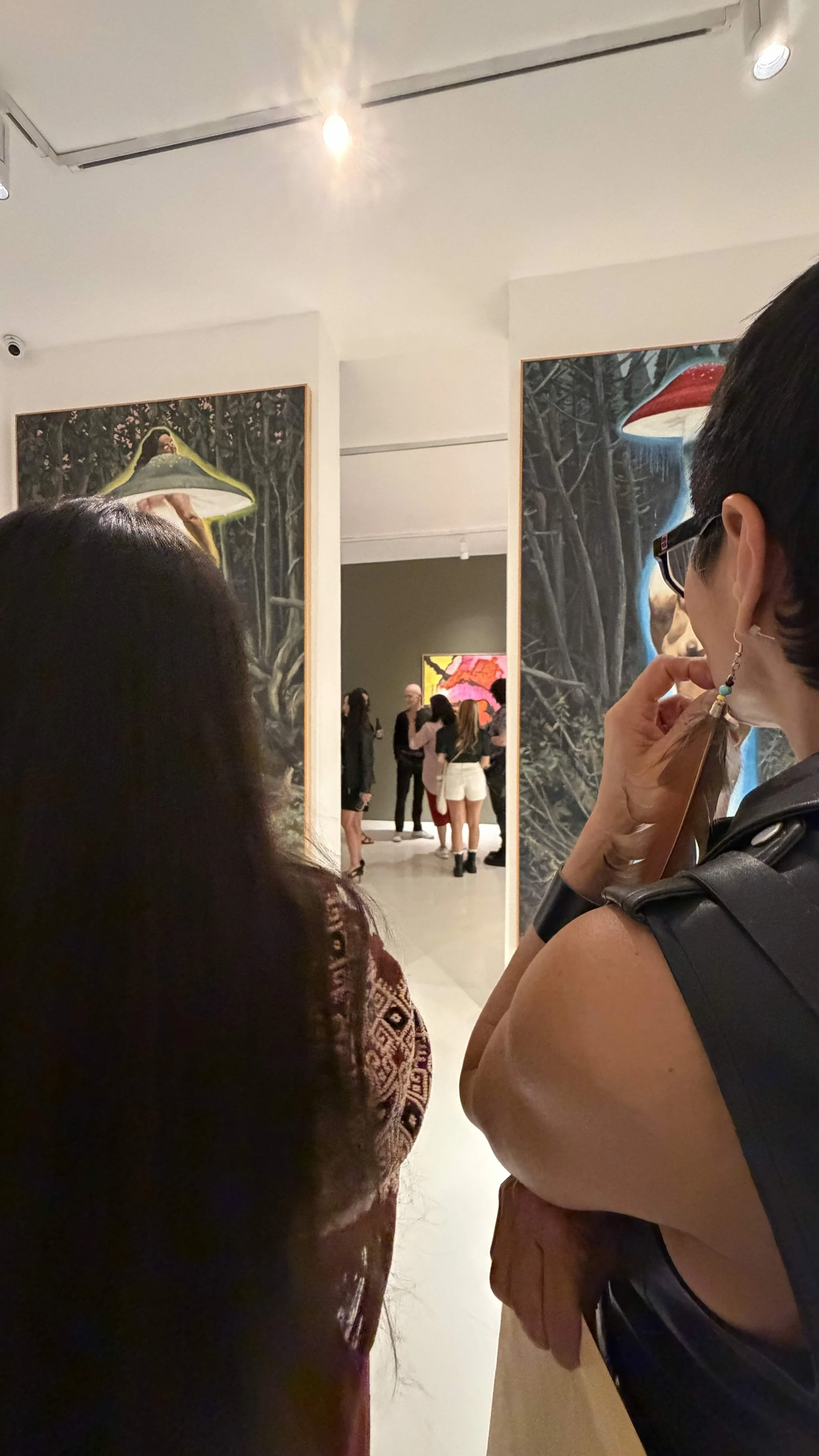
Aquí y Allá positions art as both archive and intervention—a space where memory is preserved, identities are reimagined, and new narratives emerge. Through painting, printmaking, installation, performance, sound, and moving image, the artists in this exhibition construct a living record of a people in motion.

A people in negotiation.
A people in resistance.
A people in becoming.

Presented in Mexico City, this exhibition calls on audiences not only to witness, but to reflect—to confront their own assumptions about migration, identity, and belonging. It invites a deeper recognition: that the stories of those who leave and those who return are not separate, but intertwined.

That the border does not divide experience—it multiplies it.

That belonging is not given—it is claimed, contested, and redefined.

And that in this moment of rupture and possibility, we are all implicated in the question:

¿Y ahora qué? / Now what?

Because the answer will not be found in policy alone.

It will be shaped in culture.
In memory.
In community.
And in the spaces we create—like this one—where truth can be spoken, and new futures imagined.

Curator: Dr. Martina Ayala

Aquí y Allá: El Derecho de Pertenecer

Ni de Aquí, Ni de Allá—¿Y Ahora Qué?

(Here and There: The Right to Belong / Neither Here Nor There—Now What?)

En este momento histórico—marcado por el extremismo político, el desplazamiento masivo y la violencia lenta de la erosión cultural—la migración ya no puede entenderse como un acto único de cruce. No es un inicio ni un final. Es una condición. Es un continuo. Es una vida vivida a través de fronteras, lenguas y sistemas de poder.

Aquí y Allá: El Derecho de Perteneceres una exposición binacional que reúne a artistas latinoamericanos y chicanos que viven en los Estados Unidos, junto con artistas mexicanos y latinoamericanos que trabajan en México y en toda la región. Presentada en la Ciudad de México, la exposición posiciona a la ciudad no solo como sede, sino como un sitio crítico de encuentro—donde convergen historias, se renegocian identidades y se disputa activamente el significado de pertenecer.

Esta exposición comienza con un cambio de perspectiva.

Durante décadas, las narrativas dominantes sobre la migración se han centrado en la partida—en el acto de irse, de cruzar hacia los Estados Unidos, de llegar al “otro lado”. Pero hoy, otra realidad exige atención: el retorno.

Retorno por deportación.
Retorno por autodeportación.
Retorno por necesidad, supervivencia o elección.

Y en ese retorno, se revela algo fundamental:

La migración no termina en la frontera. Comienza de nuevo.

México se encuentra en el centro de esta realidad en desarrollo. Es un territorio de tránsito para latinoamericanos que recorren rutas migratorias peligrosas. Es un espacio de retorno para quienes son expulsados de los Estados Unidos. Y sigue siendo la madre patria para los chicanos—cuyas identidades han sido moldeadas en la tensión entre herencia y desplazamiento, memoria y reinvención.

Sin embargo, el retorno no es un regreso simple.

Quienes vuelven a menudo llegan como extraños a territorios familiares—portando identidades híbridas, referencias culturales transformadas y lenguajes marcados por la ausencia y la adaptación. El inglés puede predominar. El español puede fragmentarse. El espanglish emerge no como carencia, sino como evidencia de supervivencia. El acento se convierte en marcador. La identidad en negociación.

Son vistos—y malinterpretados.
Son reconocidos—y rechazados.

Se les hace sentir, de manera implícita o explícita, que ya no pertenecen del todo ni aquí ni allá.

Ni de aquí, ni de allá.

Esta exposición habita ese espacio intermedio—no como carencia, sino como un potente territorio de producción cultural, resistencia y transformación.

Los artistas radicados en Estados Unidos exponen los mecanismos de poder que moldean la vida migrante: detención, vigilancia, racialización y criminalización del movimiento. Sus obras revelan cómo la política entra en el cuerpo—cómo fragmenta familias, altera futuros e intenta borrar la presencia cultural.

Los artistas radicados en México y en América Latina responden desde otra perspectiva: observan la llegada de quienes regresan, la aparición de nuevas identidades y las tensiones que surgen cuando la pertenencia nacional se desestabiliza. Sus obras cuestionan cómo las sociedades reciben a los suyos—cómo se regula la autenticidad, cómo se marca la diferencia y cómo se construye o se niega la solidaridad.

En conjunto, estas perspectivas conforman un diálogo binacional—una conversación a través de fronteras que trata tanto de percepción como de experiencia vivida.

Lo que está en juego son preguntas urgentes:

  • ¿Quién tiene derecho a pertenecer?

  • ¿Qué define la autenticidad cultural—y quién decide?

  • ¿Cómo sobreviven la lengua, la memoria y la tradición al desplazamiento?

  • ¿Qué responsabilidades tienen las naciones hacia quienes se van—y hacia quienes regresan?

En este contexto, la erosión cultural no es una metáfora. Se materializa a través de políticas, discursos y el desmantelamiento sistemático de la identidad, la historia y la comunidad. Es una forma de violencia que opera lentamente, de manera persistente—reconfigurando cómo las personas se ven a sí mismas y cómo son vistas por los demás.

Y, sin embargo, frente a esto, los artistas insisten.

Crean.
Documentan.
Recuerdan.
Transforman.

Se niegan a desaparecer.

Aquí y Allá sitúa el arte como archivo e intervención—un espacio donde la memoria se preserva, las identidades se reimaginan y emergen nuevas narrativas. A través de la pintura, la serigrafía, la instalación, la performance, el sonido y la imagen en movimiento, los artistas de esta exposición construyen un registro vivo de un pueblo en movimiento.

Un pueblo en negociación.
Un pueblo en resistencia.
Un pueblo en devenir.

Presentada en la Ciudad de México, esta exposición invita al público no solo a observar, sino a reflexionar—a confrontar sus propias suposiciones sobre migración, identidad y pertenencia. Invita a un reconocimiento más profundo: que las historias de quienes se van y quienes regresan no son separadas, sino entrelazadas.

Que la frontera no divide la experiencia—la multiplica.

Que la pertenencia no se concede—se reclama, se disputa y se redefine.

Y que, en este momento de ruptura y posibilidad, todos estamos implicados en la pregunta:

¿Y ahora qué?

Porque la respuesta no se encontrará únicamente en la política.

Se construirá en la cultura.
En la memoria.
En la comunidad.
Y en los espacios que creamos—como este—donde la verdad puede nombrarse y los futuros pueden imaginarse.

Curadora:Dra. Martina Ayala


3% Cover the Fee